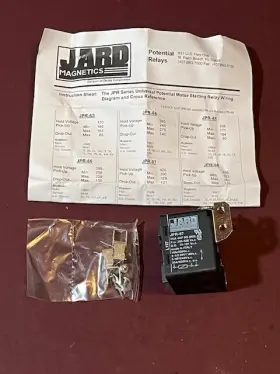
The Jard JPR-67 Potential Relay is an electro-mechanical device specifically designed for use in industrial automation and control systems. This potential relay operates based on the potential difference between two points rather than the current flow, making it an ideal solution for applications where current measurement is not required or desirable.
The JPR-67 Potential Relay features a robust and compact design, with a silver-plated contact material that ensures reliable and long-lasting performance. It is capable of handling a wide range of potential difference inputs, from as low as 50 millivolts up to 500 volts. This versatility makes it suitable for use with various types of sensors and transducers, including pressure, temperature, and flow sensors.
The JPR-67 Potential Relay is designed to operate in harsh industrial environments, with a protective coating that shields it from dust, moisture, and other contaminants. It is also capable of withstanding temperatures ranging from -40 C to 85 C, ensuring stable and consistent operation even in extreme conditions.
The relay contacts are rated for a maximum contact current of 5 amperes, making it suitable for use with low-power applications. It also comes with a built-in coil that allows for remote control of the contacts via an external current source. The coil can be energized with a voltage ranging from 10 to 30 volts DC, and it requires a minimum current of 50 mA to operate.
The JPR-67 Potential Relay is easy to install and integrate into existing control systems, with a standard mounting base that allows for easy attachment to DIN rail mounting systems. It also comes with clear markings on the relay contacts, making it easy to identify the normally open and normally closed contacts.
In summary, the Jard JPR-67 Potential Relay is a high-performance and versatile electro-mechanical device that is suitable for use in a wide range of industrial automation and control applications. Its ability to operate based on potential difference inputs, combined with its robust design and wide operating temperature range, makes it a reliable and cost-effective solution for various industrial control applications.
The Jard JPR-67 is a potential relay that is commonly used in various industrial automation applications. Here are some potential pros and cons of buying this relay:
Pros:1. High current and voltage rating: The JPR-67 relay can handle up to 10A of current and 250V of voltage, making it suitable for heavy-duty applications.
2. Compact size: Despite its high current and voltage rating, the JPR-67 relay is relatively small in size, which makes it easy to install in tight spaces.
3. Durable construction: The relay is built with a robust and durable design, which can withstand harsh industrial environments and prolonged use.
4. Versatile: The JPR-67 relay can be used in various industrial automation applications, including motor control, machine protection, and process control.
5. Easy to install: The relay comes with clear markings and a user-friendly design, which makes it easy to install and configure.
Cons:1. Limited number of contacts: The JPR-67 relay only has a limited number of contacts, which may not be suitable for complex applications that require more contacts.
2. Manual reset: The relay requires manual reset after each operation, which can be time-consuming and labor-intensive in some applications.
3. No built-in overload protection: The relay does not have built-in overload protection, which means that it may not be suitable for applications where overload protection is essential.
4. No communication interfaces: The JPR-67 relay does not have any communication interfaces, which may limit its ability to integrate with modern automation systems.
Conclusion:The Jard JPR-67 potential relay is a reliable and durable option for heavy-duty industrial automation applications that require high current and voltage handling capabilities. Its compact size, robust design, and versatility make it a popular choice among automation engineers. However, its limited number of contacts, manual reset, lack of overload protection, and absence of communication interfaces may make it less suitable for more complex applications.
Recommendation:If you are looking for a reliable and durable potential relay for heavy-duty industrial automation applications, the Jard JPR-67 is a good option to consider. However, if you require more contacts, built-in overload protection, communication interfaces, or automatic reset, you may need to consider other relay options that better suit your specific application requirements.
Details:
Jard potential relay jpr 67, new old stock.
specifications maxohvac:
- brand: Jard
- mpn: Jpr-67
shipping maxohvac:
- class: standard
- carrier: usps
- transit: 5-12 days
- type: fixed
- service: usps ground advantage
offer maxohvac:
- best offers: true
- options: ship-to-home
- availability: in stock
- in stock #: 2
- prices: $11.00–$33.75
- item condition:
- Used
- New other (see details)
- sold #: 16
- started: june 21, 2025
general maxohvac:
- category: Business & Industrial > Hvac Refrigeration
seller maxohvac:
- city: iola, texas
- rating: 100.0%
- # reviews: 244
payments maxohvac:
- other
- wallet: google-pay
- credit card: mastercard
returns maxohvac:
- policy: no returns